Island Album
Island Album
Photographs & Memories of Long Beach Island
Margaret Thomas Buchholz
Couldn't load pickup availability
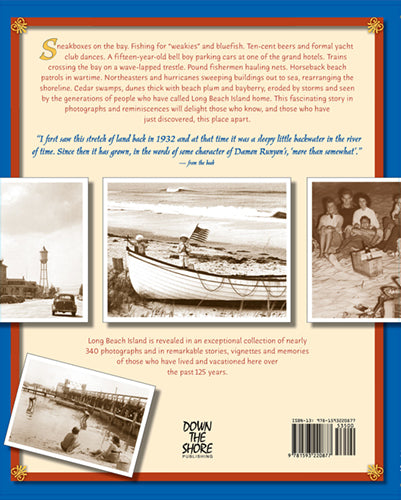
Like a great family photo album for Long Beach Island, Island Album is a delightful oversize hardcover that will be poured over and shared by the “family” of this New Jersey barrier island resort.
Here is Long Beach Island in the days of pound fishing and great hotels, but here, too, are fishermen showing off their catches and a gaggle of summer waitresses posing for a group picture in their brief spare time. Children of every decade personify summer as they romp on beaches and mess about in boats. Teenagers are teenagers, recognizable at work and play. Houses evolve from simple shanties into Victorian ''cottages'' and finally modern structures with walls of glass. But all are home to the families gathered for the camera on porch and dock.
The text, drawn from a series of remarkable interviews recorded by the LBI Historical Association over a ten-year period, combines descriptions of island life with what the Island represents to those who have known it well. This fragile strip of land between bay and ocean captures the imagination today as much as ever, and this loving evocation of its past will delight those who know, and those who have just discovered, this place apart.
Author Signed copies available - just ask!
Share
ISBN: 9781593220877
Pages: 208
Dimensions: 12” x 9.9” x 0.5"
Foreword by Larry Savadove
Review
Review
An Oral and Pictorial History of a Sliver of Sand,
By Christopher Hann / The New York Times
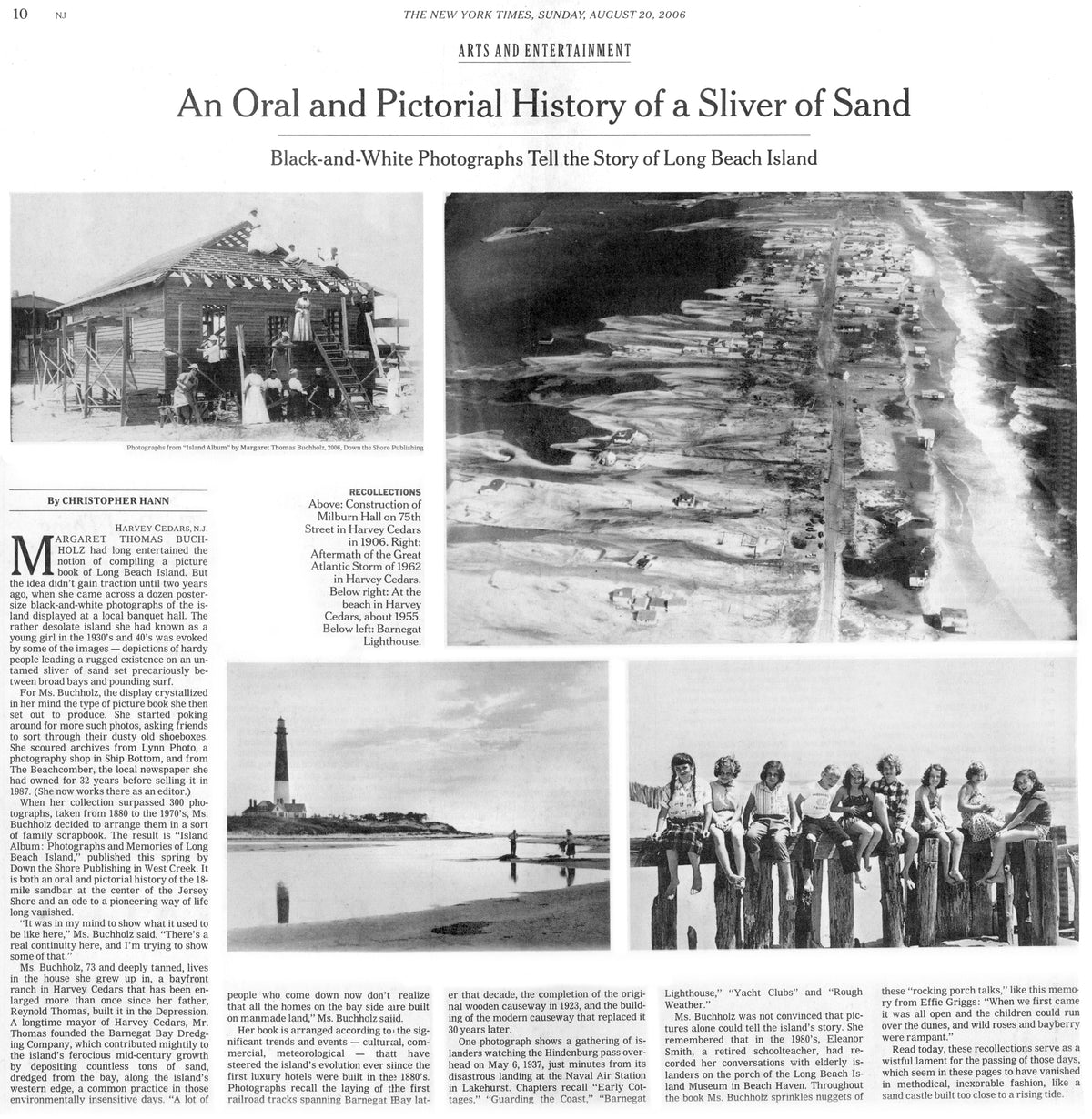
HARVEY CEDARS, N.J. - Margaret Thomas Buchholz had long entertained the notion of compiling a picture book of Long Beach Island. But the idea didn't gain traction until two years ago, when she came across a dozen poster-size black-and-white photographs of the island displayed at a local banquet hall. The rather desolate island she had known as a young girl in the 1930's and 40's was evoked by some of the images -- depictions of hardy people leading a rugged existence on an untamed sliver of sand set precariously between broad bays and pounding surf.
For Ms. Buchholz, the display crystallized in her mind the type of picture book she then set out to produce. She started poking around for more such photos, asking friends to sort through their dusty old shoeboxes. She scoured archives from Lynn Photo, a photography shop in Ship Bottom, and from The Beachcomber, the local newspaper she had owned for 32 years before selling it in 1987. (She now works there as an editor.)
When her collection surpassed 300 photographs, taken from 1880 to the 1970's, Ms. Buchholz decided to arrange them in a sort of family scrapbook. The result is "Island Album: Photographs and Memories of Long Beach Island," published this spring by Down the Shore Publishing in West Creek. It is both an oral and pictorial history of the 18-mile sandbar at the center of the Jersey Shore and an ode to a pioneering way of life long vanished.
"It was in my mind to show what it used to be like here," Ms. Buchholz said. "There's a real continuity here, and I'm trying to show some of that."
Ms. Buchholz, 73 and deeply tanned, lives in the house she grew up in, a bayfront ranch in Harvey Cedars that has been enlarged more than once since her father, Reynold Thomas, built it in the Depression. A longtime mayor of Harvey Cedars, Mr. Thomas founded the Barnegat Bay Dredging Company, which contributed mightily to the island's ferocious mid-century growth by depositing countless tons of sand, dredged from the bay, along the island's western edge, a common practice in those environmentally insensitive days. "A lot of people who come down now don't realize that all the homes on the bay side are built on manmade land," Ms. Buchholz said.
Her book is arranged according to the significant trends and events -- cultural, commercial, meteorological -- that have steered the island's evolution ever since the first luxury hotels were built in the 1880's. Photographs recall the laying of the first railroad tracks spanning Barnegat Bay later that decade, the completion of the original wooden causeway in 1923, and the building of the modern causeway that replaced it 30 years later.
One photograph shows a gathering of islanders watching the Hindenburg pass overhead on May 6, 1937, just minutes from its disastrous landing at the Naval Air Station in Lakehurst. Chapters recall "Early Cottages," "Guarding the Coast," "Barnegat Lighthouse," "Yacht Clubs" and "Rough Weather."
Ms. Buchholz was not convinced that pictures alone could tell the island's story. She remembered that in the 1980's, Eleanor Smith, a retired schoolteacher, had recorded her conversations with elderly islanders on the porch of the Long Beach Island Museum in Beach Haven. Throughout the book Ms. Buchholz sprinkles nuggets of these "rocking porch talks," like this memory from Effie Griggs: "When we first came it was all open and the children could run over the dunes, and wild roses and bayberry were rampant."
Read today, these recollections serve as a wistful lament for the passing of those days, which seem in these pages to have vanished in methodical, inexorable fashion, like a sand castle built too close to a rising tide.
© The New York Times. A version of this article appears in print on Aug. 20, 2006, Section NJ, Page 14 of the National edition with the headline: An Oral and Pictorial History of a Sliver of Sand.
Another Review
Another Review
“Each picture is fascinatingly worth the proverbial thousand words. Monstrous fish; death-defying Scandinavian fishermen; rough tents and clotheslines pitched on the dunes; grand old hotels; young people in a Ford truck forging across the beach in 1939, passing the remains of a wrecked ship. But as time fades facts, pictures alone couldn’t tell the story…. Island natives narrated tales of rum-running, raging storms, and the good life back when.”
— The SandPaper
“The 207-page book shows the island and its people from the late 1800s to the present, including many images that disappeared into attics generations ago and have never been seen in public before.”
— Asbury Park Press
“A coffee table book to be savored — not only by those who love Long Beach Island, but by anyone interested in the history of American seaside resorts.”
— The Times, Trenton
“Both an oral and pictorial history of the 18-mile sandbar at the center of the Jersey Shore and an ode to a pioneering way of life long vanished.”
— The New York Times
More Reviews
More Reviews
The Sure Pull of LBI, by Anne Levin / The Times of Trenton:
Like most seaside resorts, Long Beach Island has two populations. There are the summer people, who surge over the causeway onto the island from Memorial Day through Labor Day. And there are the year- round residents, who go quietly about their business during the rest of the year, when the beach seems deserted and the traffic jams are only an unpleasant memory.
Margaret Thomas "Poochy" Buchholz is one of those people. Though she no longer lives on the New Jersey island year round, Buchholz grew up in Harvey Cedars and still spends most of her time in that tiny town near the island's center.
Familiar to islanders from her books about LBI and her longtime job as publisher and editor of The Beachcomber newspaper, Buchholz has written a glossy new book. "Island Album" (Down The Shore Publishing, $48) is a coffee table book to be savored — not only by those who love Long Beach Island, but by anyone interested in the history of American seaside resorts.
The collection of vintage photographs focuses on the 20th century, but also includes a substantial number from the century before. The text, written in blurbs that accompany the photographs, was drawn from interviews taped over a 1O-year period, with people — many now deceased — who lived or vacationed on the island for years. "l have to admit, I am surprised at the (enthusiastic) reaction the book has gotten," says Buchholz. "The other books I did were more words and this is a lot more pictures, so maybe that has something to do with it.'
*Photos tell the story*
The author's goal was to show the progression of time through photographs. After a conversation with the longtime owner of the island's Lynn Photo Service, the idea for the book began to take shape.
"I always thought there were a lot of archival photos that hadn't been used," Buchholz says. "I happened to see a huge blowup of one, and then I came across a book in a used bookstore that got me thinking. I gathered up Lynn's photos and went into The Beachcomber's archive. I started asking friends what they had and it began to take shape."
The book is like a big family album, Buchholz's included. Her father, Reynold Thomas, was the mayor of Harvey Cedars for years and he dredged much of the bayside for development some 50 years ago. Thomas is pictured repeatedly in the book, as a child and an adult, and Buchholz and other members of her family are pictured, as well.
"Long Beach Island was my dad's summer place," she says. "His family, the Kinseys, came after the Civil War. I was born in New York, but my father's business failed in the Depression. They came here and never left. My mother was a journalist." Buchholz got a summer job at The Beachcomber and later married the editor of The Beach Haven Times. They bought The Beachcomber in 1955 and she sold it to the island's other publication, The SandPaper, in 1988. Buchholz stayed on as editor.
After she was widowed at a young age, she remarried and moved to Princeton and Philadelphia. She got divorced and found herself returning to the island every summer.
"l think the pull of Long Beach Island is the same as any summer resort where people go when they're kids," Buchholz says. "It's a very different place now from what it was, so people love to show their kids and grandkids what it used to be like."
*Memories on the right track*
"Island Album" is divided into nine chapters of striking photos and text. ln "Taking the Train," the excitement of traveling to the island is captured.
"Oh, to go and meet the train was q big event, twice a day,11 in the morning and 4 in the afternoon," says Elizabeth Ringgold Gardiner. "We fell over each other to go to the train."
"We clickety-clacked through miles of scrub growth and at last saw Barnegat Bay and inhaled the salty smell of the meadows," says Muriel Oliver Tooker. "The trip across the bay trestle seemed endless and I recall looking at the water on either side and wondering where I was going."
The chapter "Open Space" has panoramic shots of the island be fore developers blanketed it with houses. "Yacht Clubs" and "G_rand Hotels" depict an era most of to day's beach-goers don't remember. Among the most elaborate was The Engleside Hotel, built in 1876 with a high Victorian turret at one end. The hotel was demolished in 1943.
"A Red Cross unit came to the Engleside and women knitted and sewed for the soldiers in 1918. I remember knitting wash cloths. Just being in the hotel made me feel like the high and mighty for an afternoon; only the rich stayed there," says Madeline Meredith.
Among with the book's rich people are fishermen showing off their catches and deliverymen, fire and police officers at work.
"Rough Weather" touches on some of the ferocious storms islanders have weathered over the years. A series of aerial photographs give expansive views of the island communities as they grew.
Buchholz found a few surprises as her research progressed.
"Herbert Hoover was going to let the lighthouse (Barnegat Light) fall into the sea," she says, incredulously. "l couldn't believe that. l.was also surprised to learn that development work was done by the WPA (Works Progress Administration) under FDR, because this is a very Republican island."
Buchholz was particularly struck by an account of the 1872 Ship Bottom Lifesaving Station, still standing today. Ridgeway Goodwin's description of the place a few decades later is particularly evocative of the time.
"The 1872 Ship Bottom Lifesaving Station was bought by the Fell and Moon families," he says. "The house was shared by both families and could accommodate quite a good crowd. The upstairs steeping area was a long room with bunk beds built into the eaves with a window for each bed just under the roof overhang. There were two drawers under each bunk to put our clothes, and a curtain we could draw for privacy. There was a little light over the pillow so we could read if we wanted to, and I always remember how cozy it was during a storm when I could hear the rain on the roof and the crash of the surf.
"I believe there were six of these bunks which were probably used by the lifesaving crew. At both ends there were larger, enclosed bedrooms which I believe were for the officers. The downstairs was a long narrow room which was the living quarters, and at the far end a player piano that saw a lot of action. I remember a huge round table that could accommodate a goodly number of people, with huge platters of lobster, corn, tomatoes, lima beans, bowls of butter, and family gathered all around."
@ 2006 The Times of Trenton / 2006 NJ.com All Rights Reserved.
Blurb
Blurb
“There was a special smell to the cottage at Beach Haven, indigenous, I think, to the Jersey Shore. The minute we opened the front door we met it — a combination of dampness, beach sand, old wicker furniture, oil from the guns that stood racked with the fishing rods... whatever the mixture, to my nostrils it was very sweet.”
— Catherine Drinker Bowen (circa 1920s)
Excerpt
Excerpt
From the Inside Flap:
ISLANDS ARE MYTHIC PLACES. Crossing water to reach them, it is easy to feel that we're leaving the complexities of everyday life for an elemental world governed by the natural rhythms of sun and wind and tide. Albums, in contrast, root us in our past, preserving the everyday life of childhood, of animals, people and places we have loved.
Island Album presents us with both the idea and the reality of one New Jersey barrier island. Here is Long Beach Island in the days of pound fishing and great hotels, but here, too, are fishermen showing off their catches and a gaggle of summer waitresses posing for a group picture in their brief spare time. Children of every decade personify summer as they romp on beaches and mess about in boats. Teenagers are teenagers, recognizable at work and play, from the 1920s through the 1960s. Houses evolve from simple shanties into Victorian “cottages” and finally modern structures with walls of glass. But all are home to the families gathered for the camera on porch and dock.
The text is drawn from interviews recorded by the LBI Historical Association over a ten-year period. It combines descriptions of island life with what the Island represents to those who have known it well. There are stories of sailing and fishing, of long-ago treks by car, train and foot, of beach camping, life guarding and coastal rescue, of violent storms and the endless struggle to resist a hungry sea.
And of course there is some regret for wilderness lost and the slower pace of much of the previous century. Yet something quintessential about Long Beach Island remains. This fragile strip of land between bay and ocean captures the imagination today as much as ever, and this loving evocation of its past can only enhance its present.
Another Excerpt
Another Excerpt
From the Introduction by Larry Savadove:
Somewhere in the bottom drawer of your bedroom bureau is a photograph album, half full of family pictures, carefully labeled and properly enticing. It is only half full because whoever was doing the pasting and labeling got tired of the job, or overwhelmed. So on the top shelf of the hall closet sits a box of unsorted photographs, still in the envelopes from the drugstore, waiting for a place on a page.
This is a family album, the Island family. Chock full of memories. Margaret Thomas Buchholz has done the gathering and sorting and arranging. There is no narrative as such, just the comments of those who were and are part of the Island. There are some that run a paragraph or two but mostly they are snippets snatched from the past, a kind of haiku floating on the wings of memory.
There is, wisely, no attempt to order the pictures chronologically, but rather by subject, so we can see the stages of the causeway bridge, the great hotels, Barnegat Lighthouse, the Lucy Evelyn and Islander's homes. The pictures will be nostalgia to some, quaint to some, sad to some, whether you regard the Island as the place where summer lives, or home.
Margaret is one of the latter, living in the house by the bay she grew up in, still fascinated by storms and the leave-behinds of wrecks and the diaries of ancient mariners and the letters of her predecessors. You see pictures like these occasionally - in the old post office in Ship Bottom, on some restaurant walls or perhaps in somebody's album, but she has cast a wide net and caught the Island in its many phases in nearly 340 photographs, some more than 100 years old.
She is also intrigued, as all of us who live under the sea wind must be, by the constant struggle between the sea and the engineers, and some of the pictures are reminders of how that contest hasn't been settled yet.
Everybody calls Long Beach Island "my island," and everybody is right, for it belongs uniquely to each of us. But you might have trouble recognizing it in some photographs - the wide open expanse of dunes south, the lonely road north, the railway locomotive so huge and seemingly out of place on the sand. My favorite shot is of a man holding a shotgun, standing in a bare tree, one of the last of the Harvey Cedars' cedar trees.
You might find yourself in here, frolicking on the beach in a bathing suit you can't believe you wore, or as one of the lifeguards in a 1952 lineup, or rocking on the porch of the elegant Engleside Hotel, or you may find your parents or grandparents. I'm in here in a photograph I'd completely forgotten about.
And if you don't see yourself you're likely to see your house in one of many aerial views. I found the first house we ever rented, the house my father finally bought after years of renting, and the house I now live in. Sound familiar? It's a pattern many of us followed.
Beach parties, fishing parties, grand views, intimate peeks, a mini-history of beach fashions, whispers from a now never-to-be-forgotten past, they're all here, plus the family members who made them.
Put this next to your own family album. It's our island and this is its record.
© Down The Shore Publlishing. All rights reserved.